
How to Get Rid of Ringworm (& Stop It From Coming Back)
Ringworm can be frustrating to deal with, especially when a rash seems to improve only to come back or spread to another part of the body. The good news is that ringworm can be treated, but getting rid of it involves more than just treating the rash. Taking steps to stop it from spreading and preventing it from coming back are just as important. Dr Carol has medically reviewed this article to help you understand what to look for and what you can do to get rid of ringworm for good.
Key Takeaways
- Ringworm is a fungal skin infection that can spread through close contact or contaminated items.
- Treating the infection for the recommended duration is important, even if the rash starts to look better.
- Keeping your skin clean and dry and avoiding shared personal items can help prevent ringworm from spreading or coming back.
- If the rash keeps coming back, spreads, affects your scalp, or doesn’t get better with treatment, it is important to see a healthcare provider for further evaluation.
What is ringworm?
Ringworm is a fungal infection on skin, scalp, or nails. Despite its name, ringworm is not a type of worm or parasite. It is a condition that affects the body’s outer layers and can occur in different areas, depending on where the infection develops.
The infection can affect the outer layers of the body where skin, hair, or nails are present. While the name may sound unusual, ringworm is simply the name given to this type of fungal infection.
There’s no worm involved
The name ringworm can be confusing because it sounds like it refers to an actual worm. In reality, the name comes from the ring-like appearance the infection can sometimes have on the skin. The infection itself has nothing to do with worms and is caused by fungi.
It is a skin infection that affects the body’s outer layers. The confusing name can make it seem much more serious or unusual, but there is no worm involved.
What does ringworm look like?
Ringworm symptoms often include a flat, itchy patch or a ring-shaped rash. The edges may be raised, scaly, and clearly defined, while the center can look clearer, slightly scaly, or bumpy. How it looks can change based on your skin tone and where the infection appears.
- Skin tone – On lighter skin, ringworm may appear red or pink. On darker skin, it may look brown, gray, or violet, and the border can appear darker than the center.
- Scalp – Ringworm on the scalp may cause scaly patches, broken hairs, or areas where the hair becomes thinner.
- Feet (athlete’s foot) – Athlete’s foot symptoms may include dry, cracked, peeling, or blistered skin, particularly between the toes.
- Groin (jock itch) – Jock itch fungal infection appears as an itchy patch with a more defined border that gradually spreads beyond the affected area.
Although ringworm symptoms in humans can vary, the rash often changes depending on where the infection develops. This can make it hard to recognize, especially when it occurs on the scalp, feet, or groin.
Ringworm doesn’t always look like a perfect ring
Even though it’s called ringworm, the rash doesn’t always form a perfect ring. It can have an uneven or oval shape, and the edges may not always stand out clearly. Sometimes, separate patches can join together, giving the rash a more uneven shape.
As the rash spreads, its shape can change too. A small patch may slowly grow or merge with other patches, so it may not always look like the classic ring-shaped rash people often picture.
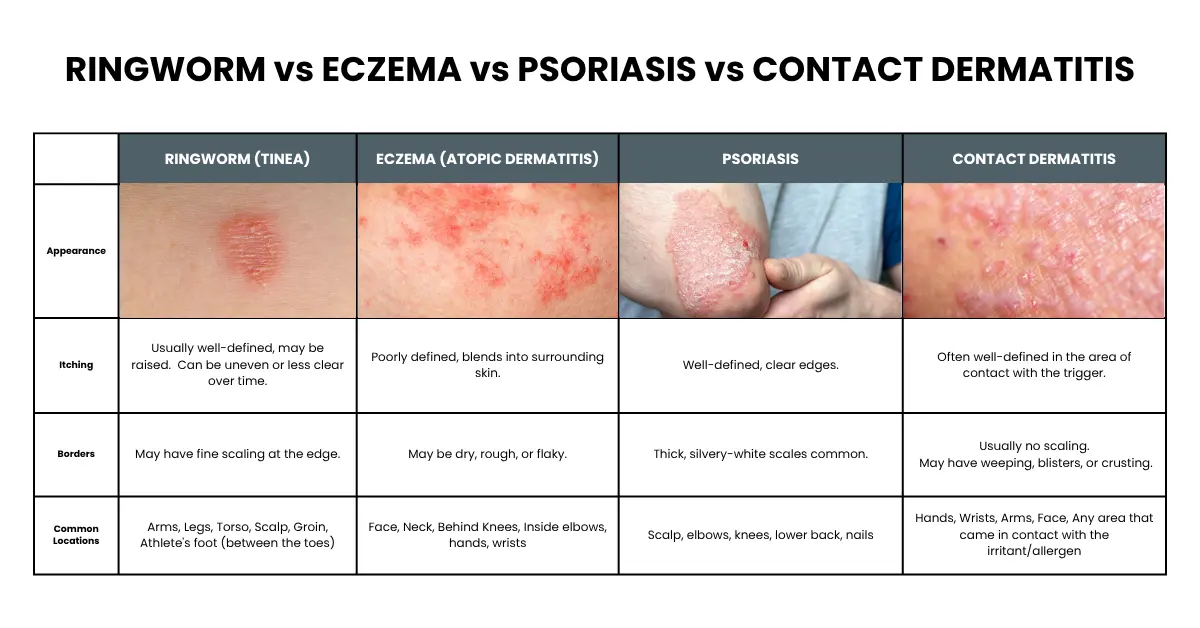
Could It Be Ringworm? The Rash Comparison
What causes ringworm?
One of the main causes of ringworm is a group of fungi called dermatophytes. These fungi live on keratin, a protein found in the skin, hair, and nails. When they grow on these areas, they can cause a ringworm infection.
Dermatophytes are a type of fungus that need keratin to grow. Since keratin is found in the outer layers of the skin, as well as in hair and nails, these are the areas that can be affected by ringworm.
How does ringworm spread?
If you’re wondering is ringworm contagious, the answer is yes. Ringworm can spread through direct contact with an infected person or animal, or by touching items or surfaces contaminated with the fungus. It can also spread from one part of your body to another. The infection is easily passed on, especially when skin comes into close contact.
Ringworm can be picked up from things such as towels, clothing, bedding, hairbrushes, and shared sports equipment. It can also spread through contact with infected pets, including cats and dogs.
You can spread ringworm before you realize you have it
There can be a delay between coming into contact with the fungus and seeing a rash, so the fungus may already be on your skin and can still be passed to others through close contact or shared personal items.
The Ringworm Clean-Up Checklist

How do you treat ringworm?
Ringworm is treated with antifungal medication to help clear the infection. Ringworm of the skin is treated with antifungal creams, lotions or sprays that contain clotrimazole, miconazole or terbinafine.
The ringworm treatment you need depends on where the infection is and how severe it is. For skin infections, antifungal treatment is applied directly to the affected area and needs to be used for the recommended duration.
How long does ringworm take to heal?
Mild ringworm on the skin usually goes away in 2 to 4 weeks with regular use of antifungal treatment. In cases where ringworm is on the scalp or nails, healing can take longer and require prescription medication.
When the infection affects the nails, it can be particularly stubborn and take longer to clear. Learn more about fungal nail infections, including the symptoms to look for and how they are treated.
The rash may look better before the infection is gone
It can be tempting to stop treatment once the rash starts looking better, but the infection may not be completely gone yet. The skin can begin to clear while some of the fungus remains, which means the rash could return if treatment is stopped too soon.
Studies show that up to 60% of people with ringworm who stop treatment early experience a recurrence of the infection within 4 weeks [pmc.ncbi.nlm.nih.gov].
When should you see a healthcare provider?
You should seek medical advice if the rash becomes painful, shows signs of a bacterial infection such as increasing redness, swelling, or pus, or if you have a weakened immune system. Getting treatment early can help prevent the infection from spreading or becoming more difficult to treat.
Some rashes can look very similar to ringworm, so it is not always easy to tell the difference on your own. A healthcare provider can examine the affected area, confirm the diagnosis, and ensure you are using the appropriate treatment.
Some types of ringworm need prescription treatment
Ringworm affecting the scalp and nails cannot be treated with creams alone. This is because the fungus is found deeper in the hair follicles or under the nail, where topical treatments cannot reach. These infections are treated with prescription antifungal tablets such as griseofulvin, terbinafine, itraconazole, or fluconazole.
Prescription treatment may also be needed if ringworm covers a large area, continues to spread, or does not improve after two to four weeks of treatment. For scalp ringworm, a healthcare provider may also recommend a medicated shampoo containing ketoconazole or selenium sulfide to help reduce the spread of the fungus while the oral medication treats the infection.
How can you prevent ringworm from coming back?
The best way to prevent ringworm from coming back is to complete your full course of antifungal treatment, even if the rash has already cleared. Keeping your skin clean and dry, avoiding shared personal items, and washing anything that has come into contact with the infection can also help reduce the risk of reinfection.
One of the most important fungal infection prevention tips is to remove anything that could still carry the fungus. Wash towels, bedding, clothing, and other personal items regularly, and avoid sharing them with others.
Frequently Asked Questions
How do you get rid of ringworm?
Ringworm is treated with antifungal medication, such as creams, sprays, or lotions for skin infections. If the infection affects the scalp or nails, you may need prescription antifungal tablets from a healthcare provider.
Is ringworm serious?
Ringworm is usually not serious, but it can spread if it is not treated. Treating the infection early can help prevent it from spreading to other parts of the body or to other people.
Can you touch someone who has ringworm?
Yes, but ringworm can spread through direct skin-to-skin contact with an infected area. It is best to avoid touching the rash and to avoid sharing personal items until the infection has been treated.
Conclusion: Keep Ringworm From Coming Back
Getting rid of the rash is only part of the process. If you really want to kick ringworm to the curb for good, it’s important to stick with your antifungal treatment. But that’s not all. A few simple habits can make a big difference when it comes to preventing reinfection. Washing towels, clothing, and bedding regularly, keeping your skin dry, and not sharing personal items can all help keep ringworm from coming back.
If you’re not sure whether your rash is ringworm, take a look at the Rash Comparison to see how it compares with other skin conditions. Once you start treatment, use the Ringworm Clean-Up Checklist to help limit the spread of the infection and reduce the risk of reinfection.