
You Can Have Parkinson’s Disease Before You Ever Notice a Tremor
A friend of mine started noticing that her husband was doing some strange things in his sleep. He would kick, shout, and sometimes move his arms as if he was actually in the middle of whatever he was dreaming about. They didn’t think much of it at first.
What makes this worth mentioning is that acting out your dreams can sometimes happen years before the movement symptoms of Parkinson’s disease appear. The same goes for things like losing your sense of smell, constipation, changes in handwriting, or becoming noticeably slower or stiffer.
That doesn’t mean you should read this and start diagnosing yourself because you’ve had constipation for a week. These symptoms can have plenty of completely unrelated causes. But if you’ve noticed several changes that don’t feel like you, this guide can help you work out which early signs of Parkinson’s disease are worth bringing up with your healthcare provider.
Key Takeaways
- Parkinson’s disease does not always start with a tremor. Changes in sleep, smell, handwriting, digestion, or movement can appear long before your hand starts to shake.
- One symptom does not mean you have Parkinson’s. But several changes that persist or worsen are worth discussing with your doctor.
- Parkinson’s affects more than movement. Sleep, digestion, speech, thinking, mood, and other parts of daily life can also be affected.
- There is no single test for Parkinson’s. Diagnosis is based on your symptoms, medical history, and physical examination.
- Parkinson’s progresses differently for everyone. A diagnosis does not mean you will immediately lose your independence.
- Treatment can help manage symptoms and maintain quality of life. Medication, exercise, physiotherapy, occupational therapy, and speech therapy may all play a role.
What is Parkinson’s disease?
Parkinson’s disease is a progressive condition that impacts how the brain controls movement. Nerve cells that make dopamine can become damaged or die. This leads to a decrease in dopamine production.
Your brain depends on dopamine to manage your movements. When dopamine levels are low, movements become slower, stiffer, and harder to control, making everyday activities challenging.
Parkinson’s affects more than just movement
It can affect your sleep, digestion, thinking, sense of smell, speech, and emotions because the nervous system is responsible for more than just controlling movement.
This is because your nervous system sends messages between your brain and every part of your body.
What are the early signs of Parkinson’s disease?
The early signs of Parkinson’s disease can include a reduced sense of smell, constipation, sleep problems, smaller handwriting, slower movement, muscle stiffness, and balance changes. These symptoms can develop gradually and are not always recognized as signs of a neurological condition.
Parkinson’s disease can affect different parts of the body, not just movement. It also affects the nervous system, which can change how other parts of the body work. Because of this, the first signs can be easy to miss, especially if they don’t relate to movement.
Could These Be Early Signs of Parkinson’s?
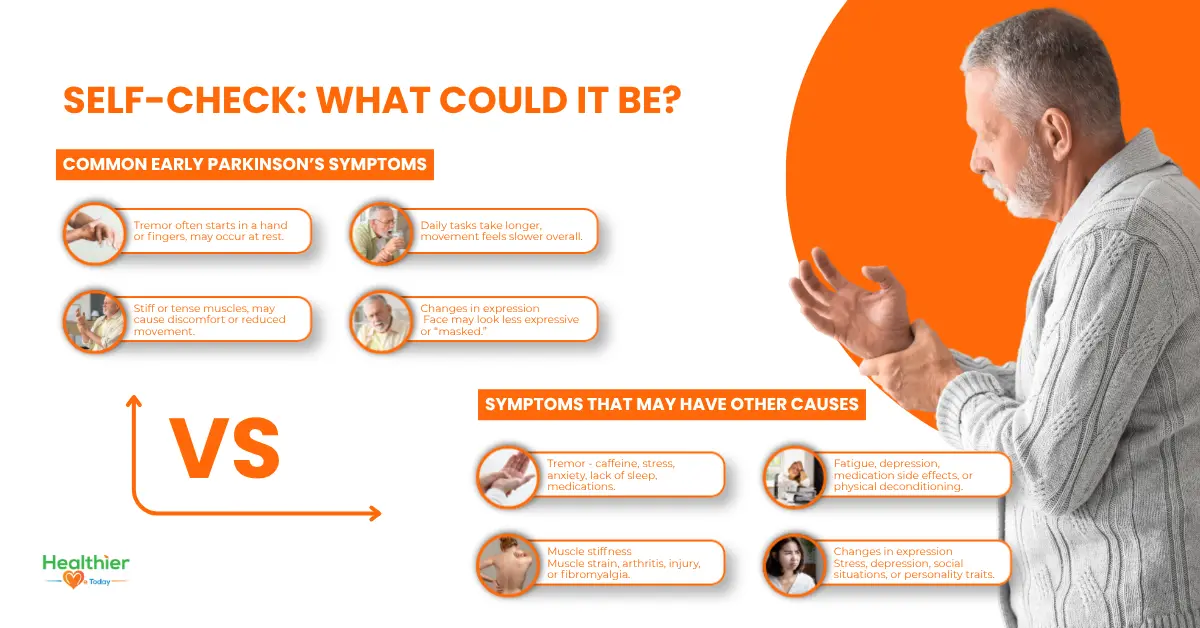 Some early signs of Parkinson’s disease may appear before noticeable tremors or other movement symptoms.
What causes Parkinson’s disease?
Parkinson’s disease develops when nerve cells in an area of the brain called the substantia nigra become damaged or die. This part of the brain is involved in controlling movement, and damage to these nerve cells is closely linked to the development of Parkinson’s disease.
The exact reason these nerve cells become damaged is still not fully understood. Researchers know that changes in the brain are involved, but there isn’t one clear reason why this happens in every person with Parkinson’s disease [michaeljfox.org].
What researchers know (and what they still don’t know)
The changes in the brain can begin years before the first obvious movement symptoms appear. By the time those symptoms become noticeable, a substantial number of dopamine-producing nerve cells in an area called the substantia nigra have already been lost.
And this helps explain something that can seem strange about Parkinson’s: why can constipation, a weaker sense of smell, or acting out your dreams show up before a tremor? Researchers believe the disease affects other parts of the nervous system before the movement-related areas of the brain are affected [my.clevelandclinic.org]. Some of these early symptoms can appear years, and in some cases decades, before diagnosis.
But there is still a huge “why?” Researchers know Parkinson’s involves the abnormal buildup of a protein called alpha-synuclein, which can form clumps called Lewy bodies, but they don’t yet know exactly why this process starts or why some people develop Parkinson’s while others don’t. Genetics and environmental factors both appear to play a role.
That is where current research gets really interesting! Researchers are looking for ways to spot these changes earlier, before so many dopamine-producing cells have been lost. If they can identify who is at higher risk early enough, it could eventually open the door to treatments that target the disease process rather than simply managing the symptoms [medicine.yale.edu].
Who is most at risk?
The risk of developing Parkinson’s disease increases with age, with most diagnoses occurring after age 60, although younger adults can develop it too. Men also have a higher risk than women. Long-term contact with certain pesticides and industrial chemicals, as well as serious or repeated head injuries, can also increase the risk.
Age is the biggest risk factor for Parkinson’s disease. Certain gene changes can also raise the risk, but not everyone with these changes develops the condition. Having one or more risk factors does not mean that a person will develop Parkinson’s disease.
A family history doesn’t always mean you’ll develop Parkinson’s
When Parkinson’s runs in a family, the condition does not affect every relative in the same way. Some gene changes are linked to a higher risk of Parkinson’s, while others have a smaller effect. Researchers are still learning how these genetic changes influence who develops the condition and why [hopkinsmedicine.org].
How is Parkinson’s disease diagnosed?
There is no single test that can diagnose Parkinson’s disease. Instead, your healthcare provider looks at your symptoms, medical history, and physical examination to understand whether the changes you are experiencing fit with Parkinson’s disease.
During the assessment, they may ask when your symptoms started and how they have changed. They will also watch how you walk and move and check your balance, muscle stiffness, and other changes while you perform simple tasks.
Ruling out other conditions comes first
Parkinson’s isn’t the only condition that can cause slowness, stiffness, or tremor. For example, essential tremor usually causes shaking when you’re using your hands rather than when they’re resting. Certain medications can also cause Parkinson-like symptoms, while conditions such as normal pressure hydrocephalus can cause walking problems, thinking changes and loss of bladder control.
That’s why your doctor will look at more than whether you’re shaking. They may review your medications, check your reflexes, balance, muscle stiffness and walking, and use blood tests or brain imaging when there’s a reason to look for another cause. An MRI usually doesn’t diagnose Parkinson’s itself, but it can help find other problems that could explain your symptoms.
And sometimes the answer isn’t immediate. Parkinson’s is diagnosed clinically, and symptoms can overlap with other forms of parkinsonism. Your doctor may need to watch how things develop over time, and in uncertain cases a movement-disorder specialist may be brought in.
What are the stages of Parkinson’s disease?
- Stage 1: Symptoms are mild and usually affect one side of the body. A person can still manage their usual daily activities.
- Stage 2: Symptoms affect both sides of the body, but balance is not yet affected.
- Stage 3: Balance problems and falls become more noticeable. A person can still live independently, but some daily activities can become harder.
- Stage 4: Walking becomes harder, and a person needs help with some daily activities.
- Stage 5: Movement is severely limited, and a person needs help to stand, walk, and manage most daily activities.
Some people live for years with very slow progression
A Parkinson’s diagnosis does not mean you only have a few years left. People with Parkinson’s now have a near-normal life expectancy, particularly with current treatment and specialist care. Parkinson’s itself isn’t usually what directly causes death. Complications such as serious infections, falls, and swallowing problems can become more important as the disease advances.
Age when symptoms begin, how quickly the disease progresses, other health conditions, cognitive changes, and the type of symptoms you develop can all affect your outlook. In one long-term population study, people with Parkinson’s had a median survival of about 16 years from the onset of motor symptoms, but the range was enormous, from about 2 years to more than 36 years.
And progression doesn’t necessarily mean suddenly becoming unable to do everything for yourself. So many continue working, driving, exercising, traveling, and managing their usual routines for years. Eventually, some people develop problems with balance, falls, freezing, swallowing, medication fluctuations or thinking and memory, but when those appear varies considerably from person to person.
The Parkinson’s Progression Roadmap
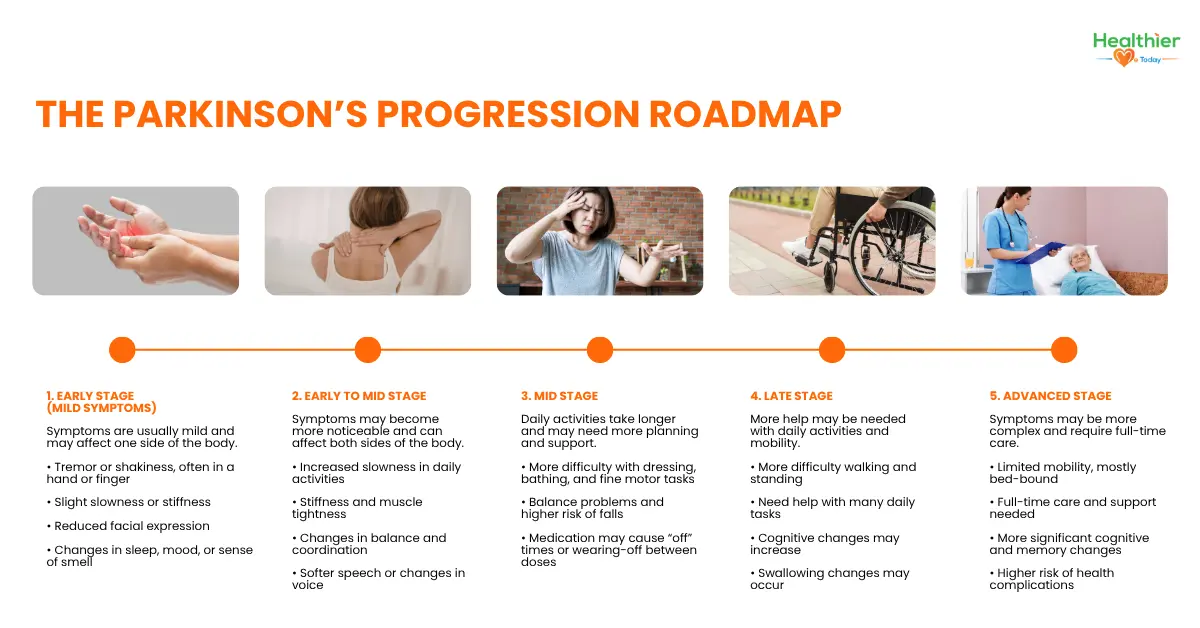 Parkinson’s disease progression can vary from person to person, with symptoms and care needs changing over time.
How is Parkinson’s disease treated?
Parkinson’s disease treatment is aimed at managing symptoms and helping you stay as active and independent as possible. It may include medication, physiotherapy, exercise, occupational therapy, or speech therapy. For some people, deep brain stimulation may also be considered when medication no longer controls their symptoms well enough.
The treatment you receive depends on your symptoms and how they affect your daily activities. Some products may also help with everyday challenges linked to Parkinson’s disease. These products do not treat Parkinson’s disease, but they may make certain daily activities easier:
- Weighted utensils for tremor support – Weighted utensils may help provide more stability when eating for people who experience hand tremors.
- Anti-slip socks – Socks with a non-slip grip may provide extra traction around the home for people who have balance problems.
- Grip strength trainer – A grip strength trainer can be used for hand exercises and may be helpful for people working on hand strength and movement, depending on their individual needs.
It often takes time to get medication right
There isn’t one Parkinson’s disease medication plan that works for everyone. Levodopa is the most effective medication for movement symptoms, but your doctor may also use dopamine agonists, MAO-B inhibitors or other medications depending on your symptoms and overall health.
Your dose may start low and be adjusted based on what happens next. Does your stiffness improve? Is your tremor better? Are you getting nausea, dizziness, sleepiness or other side effects? Later on, you may also notice that a dose doesn’t last as long as it used to, causing an “off” period before the next dose. Other medications can then be added or adjusted to extend your “on” time.
So treatment isn’t necessarily a case of “take this pill, and you’re sorted.” Your neurologist may change the dose, timing or combination as your symptoms change.
What complications can Parkinson’s cause?
Parkinson’s disease complications can include falls, difficulty swallowing, speech problems, constipation, low blood pressure, sleep problems, and changes in memory or thinking. Anxiety and depression can also occur and affect how a person feels and copes with the condition.
These complications can affect different parts of the body and make certain activities harder. Balance problems can lead to falls, while swallowing difficulties can make eating and drinking more difficult. Changes in speech, memory, or thinking can also affect how a person communicates with others.
Frequently Asked Questions
How long can someone live with Parkinson’s?
People with Parkinson’s can live for many years after diagnosis. Studies have found that median survival can be around 16 years from the onset of motor symptoms, although some people live much longer and others have a shorter course. Age, overall health, how quickly symptoms progress, and complications can all affect life expectancy.
What are five symptoms of Parkinson’s disease?
The five Parkinson’s disease symptoms include tremors, slower movement, muscle stiffness, balance problems, and changes in handwriting. These symptoms can appear in different ways and at different times, depending on the person.
How can you reduce your risk of Parkinson’s disease?
You can reduce your risk by staying physically active, looking after your overall health, and avoiding unnecessary exposure to pesticides and other toxic chemicals. However, there is no guaranteed way to prevent Parkinson’s disease.
Conclusion: Parkinson’s disease is not a countdown
Parkinson’s disease can change how you move, sleep, speak, think, and manage everyday life, but a diagnosis does not mean your independence or quality of life is suddenly over. Many people live for years with Parkinson’s, and with treatment, exercise, therapy, and regular medical care, symptoms can often be managed along the way.
If you’re reading this because you’ve noticed a tremor, changes in your handwriting, stiffness, constipation, sleep problems, or several things that just don’t feel like you, don’t jump straight to Parkinson’s. None of these symptoms proves that you have it. But they are worth mentioning to your healthcare provider, especially if they’re persistent or getting worse.
You don’t need to figure out the diagnosis on your own. You just need to know when it’s time to ask the question.