
Could Frequent Urination Be a Sign of Prostate Cancer?
Have you started needing to urinate more often than you used to? Many men see changes in their urinary habits as a normal part of getting older or assume an enlarged prostate is to blame. But if you notice a change that is new or unusual for you, it is worth getting it checked. Prostate cancer may not cause noticeable symptoms in its early stages, but urinary changes and other symptoms can develop as the condition progresses. Medically reviewed by Dr Carol, this article covers prostate cancer, including its symptoms, risk factors, diagnosis, treatment, and outlook.
Key takeaways
- Urinary changes can be linked to aging or an enlarged prostate.
- Prostate cancer symptoms may not be noticeable in the early stages.
- New or unusual changes in your urinary habits should be discussed with a healthcare professional.
What is prostate cancer?
Prostate cancer develops when abnormal cells begin to grow in the prostate, a small gland located below the bladder that forms part of the male reproductive system. Some prostate cancers grow slowly and stay within the prostate, while others can be more aggressive and spread to other parts of the body.
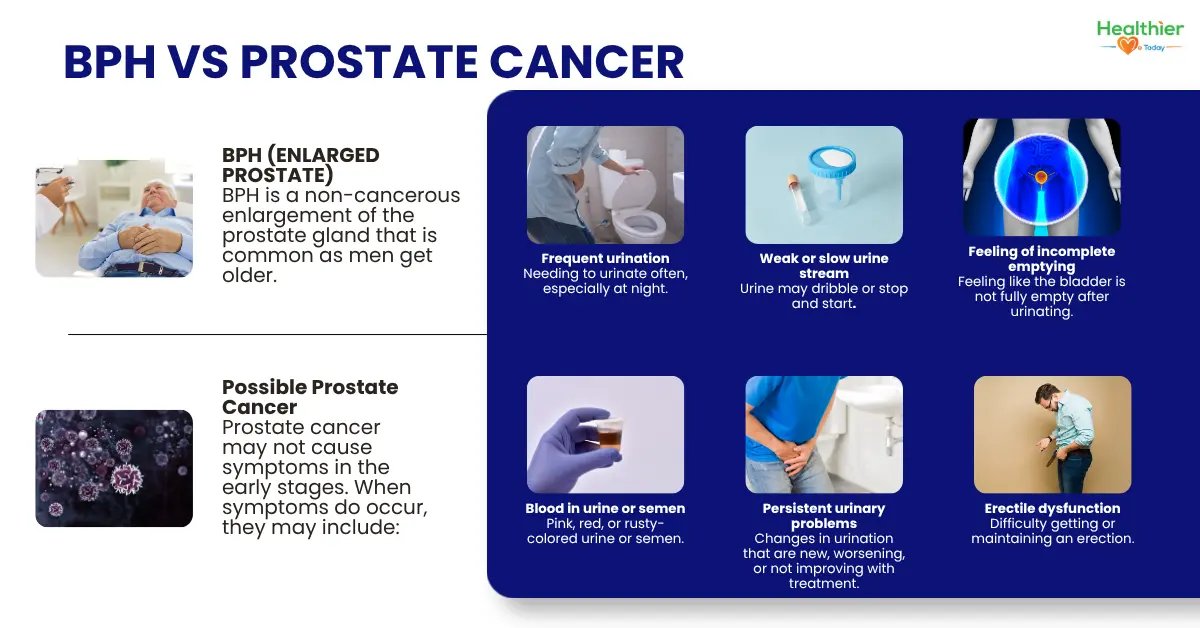
Knowing the difference between an enlarged prostate vs prostate cancer is important because the two conditions can have similar symptoms. An enlarged prostate is not cancer, but both conditions can affect urination and cause changes that can be difficult to tell apart.
If an enlarged prostate is behind your urinary symptoms, you may also be wondering how to shrink your prostate and what can actually help manage the symptoms.
It can grow for years without causing symptoms
Prostate cancer can grow for years without causing noticeable symptoms, particularly when it is small and growing slowly. In the early stages, the cancer may not affect the part of the prostate that surrounds the urethra, so it doesn’t interfere with the flow of urine. You might feel perfectly fine and have no reason to think that anything is wrong. This can allow the cancer to develop unnoticed for a long time before it is found.
Prostate cancer can remain within the prostate for years when it grows slowly, while more aggressive forms can develop faster. The way the cancer behaves can vary from person to person, and symptoms only appear when the tumor grows large enough to affect nearby structures or if the cancer spreads beyond the prostate.
What are the signs and symptoms of prostate cancer?
In the early stages, prostate cancer can develop without causing any clear signs or symptoms. As the condition progresses, changes in how you urinate can become noticeable, such as a weak urine stream, difficulty starting to urinate, or needing to go more often, particularly at night. Other signs of prostate cancer can include blood in your urine or semen, discomfort when you urinate, or persistent pain in the lower back, hips, or pelvis.
- Changes in urination – Increased urination frequency, especially at night, difficulty starting or emptying the bladder, or a weak urine flow that starts and stops.
- Pain or discomfort when urinating – A burning sensation may occur when passing urine. Blood in your urine or semen can also be a sign.
- Changes in sexual function – Erectile dysfunction or pain during ejaculation can occur, especially as the condition progresses or if it affects nearby tissues.
- Ongoing pain or other changes – Persistent lower back, hip, or pelvic pain can occur with advanced prostate cancer, along with unexplained weight loss and fatigue as the cancer progresses.
These symptoms should not be ignored, especially if they are new, persistent, or getting worse.
Some symptoms can be easy to overlook or mistake for other prostate problems. Knowing the warning signs of prostate cancer can help you recognize changes that are worth discussing with your doctor.
Many men don’t notice anything until a routine check-up
Prostate cancer can develop without noticeable symptoms in its early stages. This means a man can have the disease without knowing that anything is wrong, especially when the cancer is still small and has not affected the surrounding tissues. Doctors use a PSA test for prostate cancer to help detect changes in the prostate before symptoms become noticeable.
This is why it is important to go for regular health checks, especially as you get older. Regular check-ups can help identify prostate problems that might otherwise go unnoticed. Depending on the PSA result and individual risk factors, testing is typically repeated every 2 to 4 years, as advised by a healthcare provider [clevelandclinic].
Is It an Enlarged Prostate or Prostate Cancer?
What causes prostate cancer?
The exact prostate cancer causes are still not fully known. The disease starts when changes in the DNA of prostate cells cause them to grow and divide uncontrollably. Over time, these abnormal cells may form a tumor and, in some cases, spread beyond the prostate.
Researchers are still investigating what causes these changes and why they occur in some prostate cells but not in others. And continue to study how genetic, environmental, and other factors influence the development of prostate cancer and why certain cells become cancerous.
Who is most at risk?
The risk of prostate cancer increases with certain factors, including age, family history, and inherited genetic changes. Knowing these prostate cancer risk factors can help identify men who have a higher chance of developing the disease.
- Age – The risk of prostate cancer increases as men get older, with the risk rising significantly after the age of 50.
- Family history – Having a father or brother who has had prostate cancer increases the risk, especially when the disease has affected several close family members.
- Inherited gene changes – Inherited genetic changes, including BRCA2 mutations, can increase the chance of developing prostate cancer.
Having these risk factors does not mean that a person will develop prostate cancer, but they can increase the likelihood of it happening.
How is prostate cancer diagnosed?
A prostate cancer diagnosis usually starts with a review of your symptoms, medical history, and risk factors. A healthcare professional may perform a physical examination and order a PSA blood test to check for any changes that might require further investigation. These initial assessments help determine whether additional testing is necessary.
If there is a reason to investigate further, doctors may use scans to get a better view of the prostate and look for anything unusual. A biopsy can then be used to examine prostate tissue for cancer cells. The findings from these tests can confirm the diagnosis and show how far the cancer has progressed.
An elevated PSA doesn’t always mean cancer
A raised PSA level does not automatically point to prostate cancer. The prostate makes PSA, and the amount in your blood can increase for different reasons. An enlarged prostate, as well as inflammation or an infection, can also cause PSA levels to go up.
Even when PSA levels are higher than normal, it does not necessarily mean that cancer is the cause. Further checks may be needed to understand why the level has increased and whether there is a problem with the prostate that needs attention.
Your Prostate Testing Roadmap

What are the stages of prostate cancer?
There are four main prostate cancer stages, ranging from Stage 1 to Stage 4. The stages show how far the cancer has grown and whether it has spread beyond the prostate. The higher the stage, the further the cancer has progressed from where it first developed.
- Stage 1 – The cancer is small, confined to the prostate, and resembles normal prostate cells, with no noticeable symptoms.
- Stage 2 – The cancer remains in the prostate but has increased in size or abnormality. Stage 2 is divided into 2A, 2B, and 2C based on tumor size and cell appearance.
- Stage 3 –The cancer has spread beyond the prostate or into nearby areas like the seminal vesicles. Stage 3 is classified into 3A, 3B, and 3C based on the extent and aggressiveness of the growth.
- Stage 4 – The cancer has spread beyond the prostate to nearby lymph nodes or other parts of the body, and when it reaches distant areas like bones or other organs, it’s called metastatic prostate cancer.
Doctors determine the stage using information from tests such as a biopsy, PSA results, and imaging scans.
For a closer look at what each diagnosis can mean, our complete guide to the prostate cancer stages explains how the cancer progresses and how staging can influence treatment.
How is prostate cancer treated?
Prostate cancer treatment depends on how quickly the cancer is growing, its stage and grade, and whether it has spread beyond the prostate. The main prostate cancer treatment options include:
- Active surveillance – Slow-growing prostate cancer is monitored with regular tests, and treatment is only considered if the cancer shows growth or change.
- Surgery and radiation therapy – A radical prostatectomy removes the prostate to treat prostate cancer. Radiation therapy, using either external beam radiation or brachytherapy, can also be used to destroy cancer cells.
- Hormone therapy and chemotherapy – Medicines such as leuprolide, goserelin, and degarelix lower male hormones that support prostate cancer growth. For advanced cases, docetaxel chemotherapy can be effective, especially when the cancer has spread.
- Targeted therapy and immunotherapy – Medicines such as olaparib or pembrolizumab may be used based on the cancer’s genetic features.
The treatment recommended depends on the type and stage of the cancer, previous treatments, and the person’s overall health.
You may not even need surgery
Having prostate cancer doesn’t mean you need surgery. Some types grow very slowly and may not cause problems for years, so removing the prostate straight away is not always necessary.
Not having surgery also means avoiding possible side effects, including urinary leakage and problems with erections. Whether surgery is needed depends on how the cancer is growing, as well as your age and overall health.
What is the outlook for prostate cancer?
The outlook for prostate cancer is generally positive, especially when the cancer is found before it has spread. The overall 5-year relative prostate cancer survival rate is around 97% to 98%, showing that most men diagnosed with prostate cancer live for at least five years after diagnosis.
Survival rates are highest when the cancer remains in the prostate or has only spread to nearby areas, with a 5-year survival rate above 99%. When prostate cancer has spread to distant parts of the body, the 5-year survival rate is around 30% to 40% [seer.cancer.gov].
Survival rates have improved dramatically in recent decades
Prostate cancer survival rates are much higher today than they were several decades ago. Earlier detection, improved scans, and advances in treatment have enabled doctors to detect cancer earlier and treat it more effectively. As a result, the outlook for people diagnosed with prostate cancer is better than it was in the past.
Your prostate cancer recovery and outlook depend on factors such as the stage and grade of the cancer, PSA levels, how quickly it is growing, and your overall health. Prostate cancer that is found early and has not spread is generally easier to treat, while advanced cancer can be more difficult to control. Even when the cancer has spread, treatment can help slow its growth and manage the disease.
When should you see a healthcare provider?
It is a good idea to speak to a healthcare provider if you notice changes in the way you urinate, blood in your urine or semen, pain when passing urine, or ongoing pain in your lower back, hips, or pelvis. Regular prostate health checks are also important, particularly as you get older or if you have a higher risk of prostate cancer.
A prostate cancer screening test is often discussed from around age 50 for men at average risk. If prostate cancer runs in your family, it may be worth starting the conversation sooner, around age 45. Men at higher risk may need to discuss screening starting around age 40. Your doctor can help you decide when screening is right for you.
Don’t wait until urinary symptoms disrupt your daily life
Changes in urination are not always caused by prostate cancer, but they should not be ignored if they are new, persistent, or getting worse. Difficulty starting to urinate, a weaker urine flow, or needing to go more often can become disruptive over time, especially when symptoms start affecting your sleep, work, or normal daily activities.
You do not have to wait until these changes begin interfering with your everyday life before speaking to a healthcare provider. Getting new or ongoing urinary symptoms checked can help identify the cause and ensure any prostate problems are assessed early.
Some products can help manage symptoms related to the prostate. While they don’t treat or cure prostate cancer, they can offer support based on your needs:
- Prostate support supplement – A supplement marketed for prostate health can be used as part of a broader approach to supporting prostate function. It should not replace medical treatment or be used to treat prostate cancer.
- Nighttime absorbent pads for men – Urinary changes can occur with prostate conditions and some prostate cancer treatments. Absorbent pads can help manage urine leakage and provide added protection during the night.
- Digital bathroom scale health monitor – Tracking body weight can be useful when monitoring general health during treatment. A digital scale can make it easier to notice significant changes that can then be discussed with a healthcare professional.
Frequently Asked Questions
What are the signs of prostate cancer?
The early signs of prostate cancer can be difficult to notice, as some men have no symptoms at first. As the cancer develops, symptoms may include urinary changes, blood in the urine or semen, pain when urinating, erectile dysfunction, or ongoing pain in the lower back, hips, or pelvis.
Can you live a long life with prostate cancer?
Yes. Many people with prostate cancer live for many years, especially when it is found early and has not spread. The outlook depends on the stage and grade of the cancer, how quickly it is growing, and how well it responds to treatment.
What can you do for prostate cancer?
Treatment options include monitoring slow-growing cancers, surgery, radiation therapy, hormone therapy, chemotherapy, targeted medicines, or immunotherapy, depending on what is most appropriate.
Conclusion: Urinary Symptoms Should Not Be Ignored
Urinary symptoms do not automatically mean you have prostate cancer, but new or ongoing changes should not be ignored. If you are unsure whether your symptoms could be linked to an enlarged prostate or prostate cancer, reviewing the Enlarged Prostate vs. Prostate Cancer comparison can help you understand the difference.
If your healthcare provider recommends further testing, the Prostate Testing Roadmap can help you understand what to expect during the next steps. Speaking to a healthcare provider about changes early can help ensure the right checks are carried out when needed.